Biblioteka Nowa
Library and Mediatheque Building

meandering reading space

Rzeszow, Poland
2025
competition
with Kalata Architects, Warsaw


groundfloor bistro area
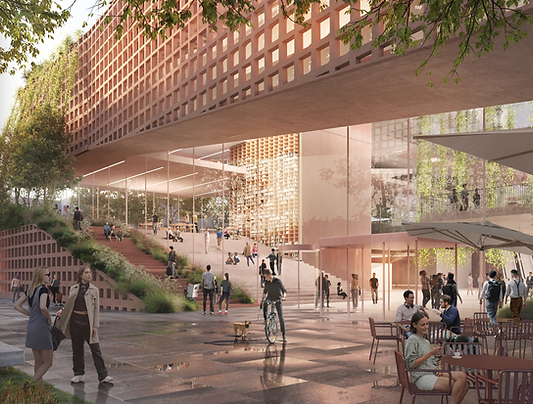
main entry with the grand stair

Architectural Concept
The proposed building for the Biblioteka Nowa
is more than just a library; it serves as a multifunctional urban space for the 21st century.
It provides an opportunity to engage with literature and culture within a new urban garden setting, offering an alternative to the nearby shopping gallery that promotes consumer culture. The library's interior, featuring large glass areas, connects with a linear green city park. This park is forming a green spiral ribbon that culminates in an observation tower with panoramic views of Rzeszów.
The building's form is inspired by the Hanging Gardens of Babylon and embodies Cicero's idea that "libraries and gardens are essential for spiritual growth." The structure aims to serve the city's residents as a public space, supporting their spiritual and social development.
The main concept of the design is a spiral structure
- a ramp that leads from ground level to the rooftop, creating a green oasis in the city. The rooftop serves as a green garden with public functions including an exhibition space, an open-air cinema, a basketball court, chess fields, a playground, picnic areas, and a café. Inside the spiral, the layout adopts an open-plan design with flexible, movable walls that allow for space modification.
Reading areas are accessible to everyone, with a central communication system enabling easy movement via walkways and elevators. Access to designated areas like closed stack sections, valuable and historical collections, and staff zones is controlled by card access gates.

spiral roof park


entry level with multi-functional hall


green roof


Eco-Concept
The building incorporates eco-friendly and energy-efficient solutions, particularly in energy supply and rainwater management. It utilizes renewable energy sources such as PVT panels and heat pumps, green roofs, and a rainwater retention and reuse system. The recycled ceramic facade functions as passive cooling, enhancing the building's overall energy efficiency.
A green roof is designed as a usable space, complemented by indoor, atrial, and external greenery. Vegetation cables additionally shade the facade. The rainwater retention and reuse system ensures sustainable water management. The design includes retractable sun blinds, passive interior lighting, and natural ventilation options.
The concept aims for a simple, coherent, and energy-efficient system. It's estimated that the proposed investment will use one-third less energy and 50% less water than comparable reference buildings that meet only minimal legal requirements.
The mechanical ventilation system will be optimized to reduce thermal and electrical energy use, employing high-efficiency heat recovery (minimum 85%) and low fan power units with top-class sealing.
Separate ventilation systems for each building's parts, with variable air supply regulated based on humidity/CO2 sensors to direct air where needed. All air conditioning units will feature energy-saving engines.